

BHUTAN - Mindfulness City Masterplan Unveiled
In a groundbreaking announcement, His Majesty the King of Bhutan has unveiled the Mindfulness City, a transformative urban development crafted by globally renowned architecture firms Bjarke Ingels Group (BIG), Arup, and Cistri.
Rooted in Bhutanese philosophy and inspired by the nation’s unique Gross National Happiness (GNH) index, the Mindfulness City is envisioned as both an economic catalyst and a living embodiment of mindful progress. The masterplan, designed by BIG’s Landscape and Urban Design Team, integrates green technology, education, and infrastructure to establish the Gelephu Special Administration Region (SAR) as a new bridge between South Asia and Southeast Asia.

Designing a City of Harmony and Human Consciousness
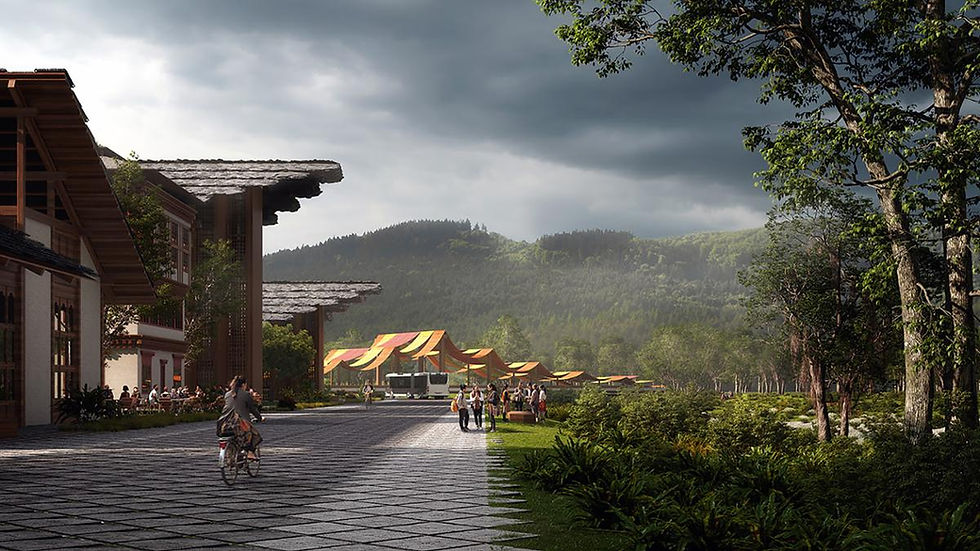
Set against the majestic backdrop of Bhutan’s mountains, forests, and rivers, the Mindfulness City amplifies biodiversity by interweaving ecosystems, communities, and culture into one cohesive design. The city unfolds in ribbonlike paddy fields, cascading from the hills to the valley — a poetic balance of the built and the natural, the ancient and the advanced.
Density gradually increases from rural highlands to urban lowlands, ensuring a fluid integration between ecological and social systems. This seamless layering of landscape intelligence and cultural symbolism transforms the city into an organism that grows with its environment — a concept reminiscent of Brainspan, where long-term cognitive vitality thrives through harmony and balance.

Mandala Urbanism: The Architecture of Meaning
The masterplan introduces 11 distinct neighborhoods, each designed according to the principles of the Mandala — an ancient geometric symbol of unity, balance, and consciousness. Each neighborhood is centered around shared public spaces, nurturing both community vitality and mental well-being.
This mindful structuring mirrors the philosophy behind Performancespan: a framework for enduring mastery, where clarity and intentional design enable lasting influence. Just as leaders cultivate Performancespan through strategic energy management, Bhutan’s Mindfulness City cultivates urban performance through ecological design and cultural continuity.
To protect against monsoon flooding, vast paddy fields will line the rivers, functioning as biodiversity corridors and wildlife migration sanctuaries — further reinforcing Bhutan’s deep-rooted harmony with nature.


Inhabitable Bridges: Where Culture Meets Connectivity
At the heart of the plan are “inhabitable bridges” — architectural arteries that connect the 11 neighborhoods and house key civic destinations such as the airport, spiritual center, healthcare facilities, and university.
Each bridge corresponds to one of the nine GNH domains, encompassing psychological well-being, education, health, good governance, and cultural diversity. These bridges represent both physical connections and symbolic continuities, embodying Bhutan’s integration of material progress with spiritual purpose — an expression of performative wisdom, where action is guided by insight.

The Future of Mindful Living
Built with local materials such as wood, stone, and bamboo, the Mindfulness City pays homage to Bhutanese craftsmanship and vernacular design. Every element of the project — from architectural motif to ecological rhythm — resonates with the principles of sustainable prosperity and collective longevity.
In this sense, Bhutan’s Mindfulness City becomes more than an urban plan; it is a philosophy in motion, embodying how modern societies can build with purpose, thrive with consciousness, and live with enduring clarity — the same ideals explored in Brainspan and Performancespan, where longevity evolves from a biological metric into an intelligent way of living.


Extending Horizons. Elevating Life.


Comments