

The Gstaad Intelligence Brief: Where the Next $10B in Longevity Capital Will Flow
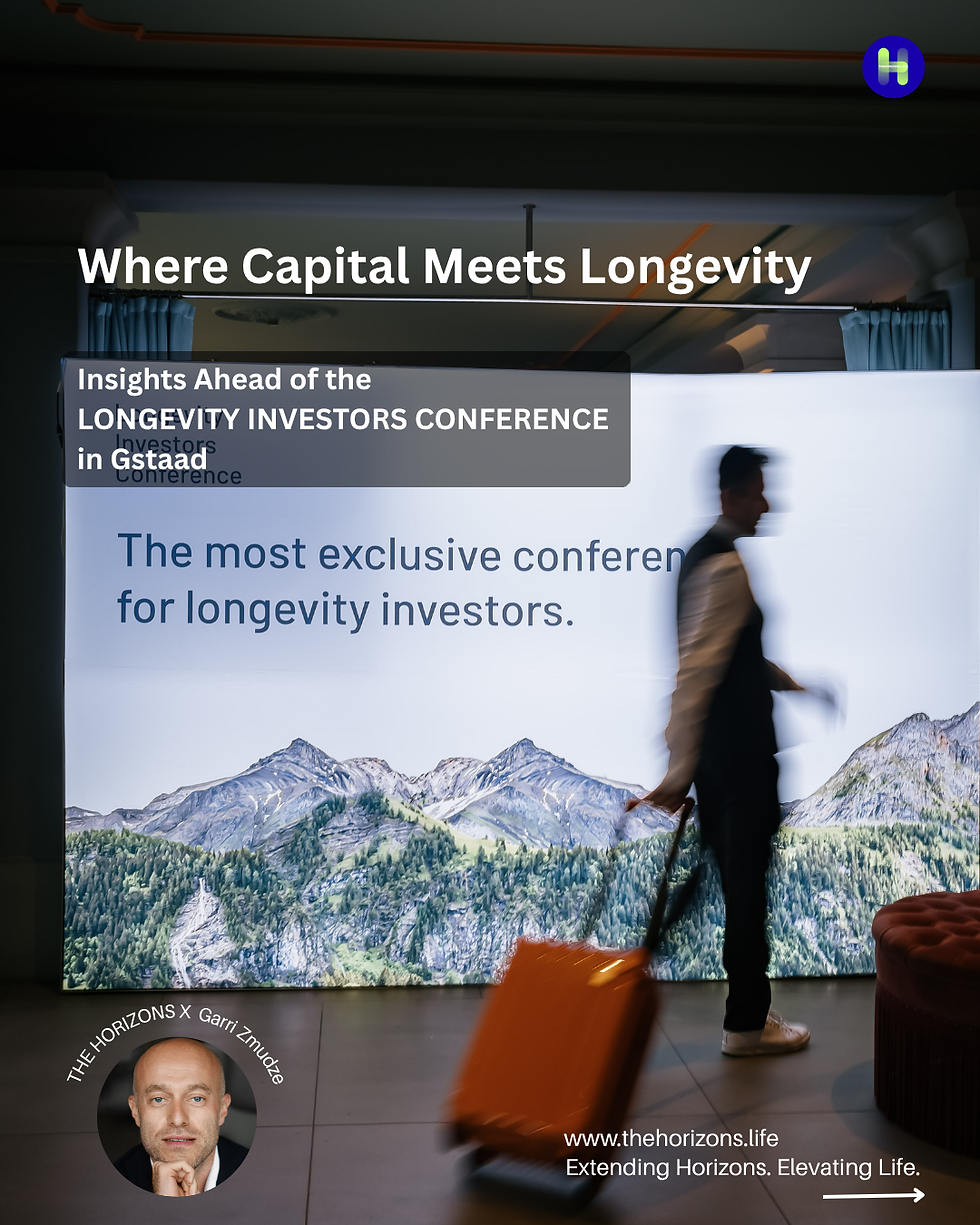
Direct macro intelligence synthesized from main-stage keynotes and private allocator dialogues at the seventh Longevity Investors Conference in Gstaad.
What Top Allocators at the Longevity Investors Conference Are Quietly Rotating Out Of—and the Sovereign Infrastructure Replacing It.
High above the pristine valley of Gstaad, behind the heavy timber doors of Le Grand Bellevue, the conversation surrounding longevity underwent a quiet but radical shift. Hosted by Marc P. Bernegger and Dr. Tobias Reichmuth—co-founders of the Longevity Investors Conference (LIC)—and welcomed by owner and Managing Director Daniel Koetser, the gathering set aside the grand claims of biohacking showmanship and consumer lifestyle marketing. In their place sat institutional allocators, single-family office principals, and multi-billion-dollar fund managers engaging in a far more sober exercise: re-pricing risk, evaluating unit economics, and quietly deciding where capital must be withdrawn—and where it must urgently flow.
What makes this analysis distinct is its dual-layer vantage point. True market intelligence is rarely found in keynotes alone, nor is it contained purely in off-stage rumors. By capturing the grand frameworks presented on the main stage and immediately pressure-testing them across closed-door peer roundtables, private dinners, and informal raclette mountain lunch, a clearer picture emerges: the speculative first era of consumer longevity has run its course. The early narrative—dominated by direct-to-consumer (DTC) supplement brands, celebrity endorsements, and oversimplified biological age clocks—is giving way to an infrastructure era defined by hard biological platforms, indication-first clinical routes, and high-trust capital networks.

The Capital Realignment: $18.4B Longevity Biotech vs. $212B AI
To understand where the next $10 billion will be deployed, one must first examine the global allocation landscape framed on the main stage. In 2025, AI venture capital absorbed a staggering $212 billion, while longevity biotech captured $18.4 billion—a record 4x surge from 2024’s $4.7 billion baseline, with over $12 billion deployed year-to-date in 2026. While generalist tech funds have driven AI valuations into hyper-saturated territory, keynote analysis revealed that longevity biotech offers an extraordinary valuation arbitrage. Yet, main-stage data immediately exposed a sharp internal disparity within the sector: in Q1 2026, while the average longevity deal size reached $91.2 million, the median deal sat at just $21.8 million.
This "barbell" capital distribution confirms that capital is not falling uniformly across the market. A small cohort of late-stage, mega-cap platform plays is inflating the headline mean, while the true operational baseline remains anchored around lean, clinical-stage rounds. In closed-door allocator roundtables that followed, LPs pressure-tested this data, arriving at a clear consensus: institutional capital is aggressively concentrating into a top tier of de-risked, platform-level assets, resulting in a silent rotation away from speculative consumer setups.
The Institutional Opportunity: Unlocking "Supplements 2.0"

Over dinner at Le Grand Bellevue, allocators and founders discussed the structural shifts reframing the consumer wellness asset class. First-generation direct-to-consumer (DTC) models—built around unbranded white-label supplements and heavy performance-marketing budgets—have faced severe margin compression driven by skyrocketing customer acquisition costs (CAC) and high 30-day consumer drop-off rates. While consumer oral supplements command nearly a third of direct-to-consumer retail wellness spending globally, unbranded DTC setups now struggle to secure venture and private equity follow-ons.
However, rather than signaling an exit from consumer longevity, this margin squeeze highlights a massive market opportunity: the rise of institutional-grade, clinically validated interventions - Supplements 2.0. The institutional narrative surrounding single-molecule "panaceas" is maturing rapidly. Where precursors like NAD+ were once marketed strictly as broad-spectrum consumer longevity products, allocators now demand step-by-step biological rigor: verified manufacturing purity, human clinical trial endpoints, and measurable biomarker outcomes.
This marks a definitive transition from "NAD+ 1.0"—commodity precursors plagued by poor bioavailability—toward an institutional paradigm defined by targeted liposomal delivery, enzymatic CD38 inhibitors that prevent cellular degradation, and IP-protected, indication-first clinical pipelines.
For forward-thinking allocators, the alpha lies not in abandoning consumer interventions, but in backing science-first platforms that bridge daily consumer habits with data-driven, preventive longevity infrastructure.
The Regulatory Wedge: The "Indication-First" Consensus
Main-stage presentations underscored a fundamental regulatory reality: with global health authorities (FDA/EMA) not recognizing biological aging as a standalone indication, market leaders are executing an 'Indication-First' clinical route.
Off-stage peer dialogues translated this reality into a pragmatic, universal investment strategy: the "Indication-First" Clinical Wedge. Rather than seeking approval for generic "anti-aging," market-leading platforms are anchoring their biology to validated, disease-specific targets first:
Targeted Clinical On-Ramps: Platforms like Life Biosciences initiated human dosing for ER-100 (epigenetic reprogramming) by targeting specific, recognized diseases—specifically glaucoma and Non-Arterial Anterior Ischemic Optic Neuropathy (NAION). Similarly, NewLimit (backed by a $435M Series C) is focusing its cellular reprogramming platform toward an initial 2027 clinical trial in liver tissue.
De-Risking Big Pharma Exits: In peer exchanges, investors consistently cited this approach as the primary prerequisite for Big Pharma M&A. Establishing safety and efficacy in a recognized disease category creates a clear valuation and licensing framework for acquirers.
The Gerotherapeutic Dividend: Once an indication-first drug secures primary approval and cash flow, follow-on trials and off-label expansion unlock its systemic gerotherapeutic potential across broader healthspan indications.
The Diagnostic Disconnect: Moving Beyond the 4-Protein Illusion
A major point of friction across allocator roundtables was the state of consumer diagnostics. Many commercially available "biological age" panels rely on measuring a mere handful—often no more than four—routine blood biomarkers. In Gstaad’s private sessions, this approach was broadly characterized as a commercial illusion.

The human proteomic ecosystem encompasses upwards of 9,000 functional proteins active in human plasma. Furthermore, static testing frequently misses real-time physiological dynamics: unless activated by targeted mechanical or metabolic stress—such as resistance exercise—unutilized amino acids and degraded systemic proteins are metabolized and cleared as nitrogenous waste without registering meaningful baseline changes.
Institutional capital is consequently moving upstream into deep, high-resolution diagnostic infrastructure: comprehensive multi-omic mapping, non-invasive testing arrays, high-field MRI/MRA neuro-imaging, and neuro-state monitoring (MU) designed to capture true biological baselines.
The Restorative Frontier: Clinical Sleep Infrastructure ($3B+)

Beyond molecular diagnostics and cellular therapies, allocators identified specialized restorative infrastructure—a rapidly compounding $3B+ market segment—as one of the most defensible physical plays in the longevity ecosystem.
Because chronic sleep fragmentation and elevated sympathetic drive directly accelerate cardiovascular aging, disrupt brain glymphatic clearance, and deplete cognitive bandwidth, institutional capital is moving past passive tracking. Smart capital is deploying into active nervous system regulation: bio-harmonized sleep architecture, neuro-acoustic entrainment, mobile breathwork protocols, and restorative physical environments.
By bridging environmental hardware with real-time biometric down-regulation—whether in luxury residential suites or executive transit corridors—this asset class delivers high-margin physical deployment backed by measurable physiological outcomes.
The Metabolic Horizon: GLP-1s, the Gut-Brain Axis, and Inflamaging
Perhaps the most significant clinical thesis shift discussed behind closed doors centered on metabolic biology and incretin therapies. While public markets view GLP-1 receptor agonists through the narrow lens of weight loss, institutional longevity capital views them as powerful multi-organ tools for downregulating systemic inflamaging—the chronic, low-grade inflammation driving age-related decline across the cardiovascular, neuro-vascular, and metabolic systems.
This recontextualization is driving capital into three distinct metabolic investment fronts:
Beyond Weight Loss: The Systemic Anti-Inflammatory Thesis: Institutional allocators are prioritizing incretin-based platforms not for cosmetic body composition, but for their ability to arrest systemic inflammation. By targeting visceral adiposity, endothelial dysfunction, and neuro-inflammation, GLP-1 and dual/triple agonists (GIP/Glucagon) are establishing a new baseline for multi-disease risk reduction and cardiovascular healthspan preservation.
Endogenous Gut-Brain Modulation & Neuro-Signaling: Moving downstream, smart capital is targeting the gut-brain axis as a primary lever for cognitive and systemic resilience. By leveraging targeted soluble fiber architectures and precision microbiome therapeutics that mimic natural GLP-1 pathways, these platforms stimulate endogenous gut-derived serotonin production (~90% of systemic serotonin) and neuro-protective signaling. The clinical returns extend far beyond glycemic control—mitigating vascular stiffening, stabilizing mood, and protecting against age-related sensory decline.
Scalable Lifestyle Infrastructure (The Yojo 2.0 Blueprint): To prevent muscle wasting (sarcopenia) and lifestyle dependency associated with continuous pharmaceutical GLP-1 use, allocators are backing translational lifestyle frameworks like Yojo 2.0. By harmonizing the four foundational pillars—food, movement, mindset, and environment—with digital monitoring and community support, these models deliver high-margin, planet-friendly, and economically accessible longevity solutions designed to scale impact and retention 10x.
For forward-thinking allocators, the metabolic horizon is no longer about prescribing a single pharmaceutical molecule. The true alpha lies in backing integrated platforms that combine targeted pharmacotherapy with bio-active gut nutrition and sustainable, scalable behavioral infrastructure.
The Macro Shift: Sovereign Health & The Collaborative Ecosystem
Ultimately, the private dialogues in Gstaad pointed toward a profound paradigm shift: the distinction between Reactive Healthcare and Sovereign Health. Legacy healthcare is an external, reactive system—a high-cost liability that intervenes only after biological failure occurs. Sovereign Health, by contrast, is rooted in personal ownership, continuous control, and proactive baseline optimization.

Yet, as allocators acknowledged across every private roundtable, the longevity industry remains at an early, foundational stage. No single capital group, clinical laboratory, or biotech platform can construct this sovereign asset class in isolation. Building a sustainable ecosystem requires synchronized, supportive growth across every dimension:
Pioneering Scientists & Biotech Founders pushing cellular frontiers and indication-first trials.
Institutional Capital & Allocators providing patient, disciplined liquidity structures.
Specialized Clinical Infrastructure & Tech Developers bridging diagnostics, sleep science, and recovery environments.
Strategic Media & Intelligence Platforms framing sovereign asset classes, bridging asymmetrical knowledge gaps between capital and science, and translating complex geroscience for global leaders—accelerating capital deployment toward mass adoption, driving down the cost curve, and ultimately making longevity accessible to all.
For institutional allocators, Sovereign Health represents the ultimate long-term thesis: asset models built on high-retention software, non-invasive diagnostic precision, specialized clinical sleep technology ($3B market segment), and systemic anti-inflammatory biology. The early speculative wave of longevity is officially behind us. The infrastructure era—built through cross-industry collaboration—has begun.
THE HORIZONS Perspective: Challenging the AI Adherence Consensus
While the room in Gstaad converged heavily on the idea that 24/7 AI-driven personalization will automatically solve the industry’s notorious 30-day adherence wall, we remain deliberately skeptical.
The consensus assumes that continuous biometric feeds and algorithm-driven nudges will turn passive protocols into permanent habits. In practice, software alone does not rewrite human psychology. Pushing continuous AI alerts onto users frequently triggers notification fatigue and cognitive friction, accelerating drop-off rather than preventing it. Real adherence is fundamentally a psychological, environmental, and behavioral challenge—not merely a data delivery problem.
And beneath that surface lies an even deeper question: If classical AI is merely pattern-matching legacy health data to manage behavior after the fact, are we solving the right computational layer at all?
As quantum simulation, biocomputing, and next-generation deep-tech architectures begin quietly intersecting with life sciences across specialized European hubs, the frontier of longevity capital is moving far beyond simple app notifications. The true computational leap—and where the next paradigm of biological simulation is heading—is a thesis we are reserving for our upcoming exclusive intelligence briefing.
Gain direct access to macro intelligence, closed-door capital metrics, and analytical perspectives decoding the future of luxury, wellness, and longevity
More photos:
Extending Horizons. Elevating Life.


Comments